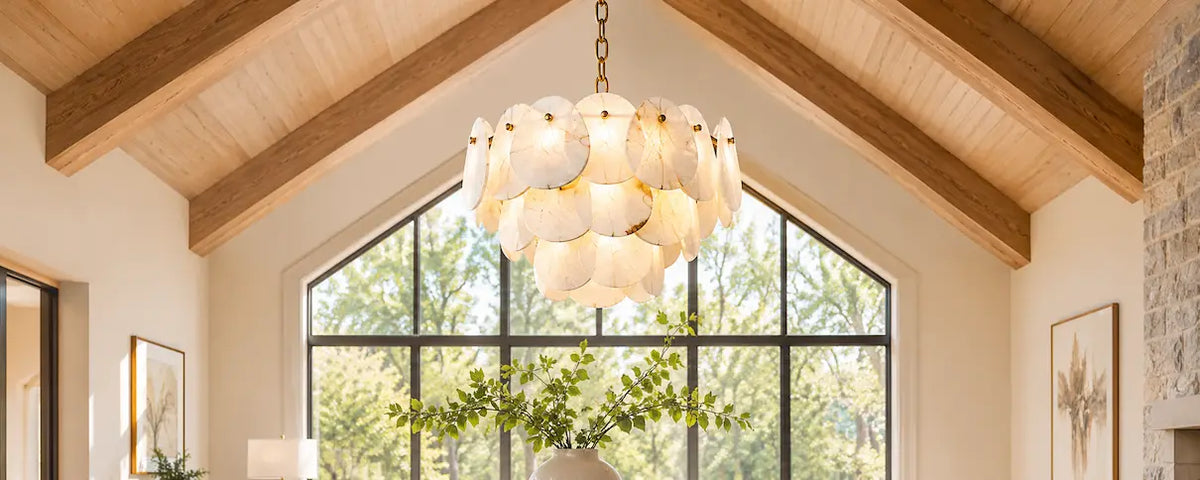
Chandeliers for Vaulted Ceilings: Size, Height and Placement
A vaulted ceiling breaks most of the usual chandelier rules. The ceiling isn't one height, the fixture often can't hang from a flat surface, and a light that looks right in a standard room can disappear into all that open space. Choosing a chandelier for a vaulted ceiling comes down to four questions: where to measure, how big to go, how low to hang it, and how to mount it on a slope. This guide answers each one in turn.
What you'll learn:
- How to Measure a Vaulted Ceiling for a Chandelier
- What Size Chandelier for a Vaulted Ceiling?
- How Low to Hang a Chandelier on a Vaulted Ceiling
- Where to Hang a Chandelier on a Vaulted Ceiling
- How to Mount a Chandelier on a Sloped Ceiling
- Which Chandelier Shapes Suit a Vaulted Ceiling?
- The Bottom Line
- FAQ
How to Measure a Vaulted Ceiling for a Chandelier
The first question is where to measure, since a vaulted ceiling has a low edge and a high peak. For sizing, the number that matters is the ceiling height at the point where the chandelier will hang. In most vaulted rooms that's the peak, so measuring from the floor straight up to the highest point gives you the figure to use.
Two more measurements finish the picture:
- Room length and width. These set the chandelier's diameter, just as they do in a flat-ceiling room.
- The height of the low wall. This shows how steep the slope is, which matters later when you choose how to mount the fixture.
If the chandelier will hang somewhere other than the peak, such as over a dining table set off to one side, measure the ceiling height at that exact spot instead.
What Size Chandelier for a Vaulted Ceiling?
With those numbers in hand, sizing uses the same two formulas as any room, with one adjustment for height. You can work through them below, or skip the math with the chandelier size calculator.
The diameter comes from the floor area.
Diameter (inches) = room length (ft) + room width (ft)
A 16 by 20 foot living room, for example, adds up to 36, so a chandelier about 36 inches across is a good starting point. Some designers size up by another 10 to 20% under a vaulted ceiling, since the open space above makes a fixture look smaller than it is.
The fixture's height comes from the ceiling height you measured.
Height (inches) = ceiling height (ft) x 2.5 to 3
For very tall vaulted rooms, around 16 feet or more at the peak, the multiplier rises to 3 to 3.5, the same rule used for double-height foyers. A taller fixture fills the vertical space, which is why tiered and multi-level chandeliers tend to suit vaulted ceilings so well.
How Low to Hang a Chandelier on a Vaulted Ceiling
Once you know the fixture's size, the next decision is how far down to hang it, and this is where vaulted rooms most often go wrong. It's tempting to keep the chandelier up near the peak, out of the way. Hung that high, though, it reads as part of the ceiling and throws little useful light on the room below.
The better aim is to bring the fixture down into your line of sight while keeping its lowest point at least 7 feet above the floor wherever people walk. In open living areas, many lighting retailers suggest a bottom height of about 8 to 10 feet, and the taller the ceiling, the closer to 10 feet it can go.
| Ceiling height at the peak | Fixture height | Bottom of the fixture above the floor |
|---|---|---|
| 12 ft | 30 to 36 in | About 7.5 to 8 ft |
| 14 ft | 35 to 42 in | About 8 ft |
| 16 ft | 48 to 56 in | About 8 to 9 ft |
| 18 ft | 54 to 63 in | About 9 to 10 ft |
| 20 ft | 60 to 70 in | About 10 ft |
The fixture heights come from the formulas above, and the bottom heights are a starting range rather than a fixed rule. Over a dining table, the table takes over as the reference point: the bottom of the chandelier usually sits 30 to 36 inches above the tabletop, however tall the ceiling is, just as it does when hanging a chandelier over a dining table under a flat ceiling.
Where to Hang a Chandelier on a Vaulted Ceiling
Height is only half of placement. The other half is where along the slope the chandelier hangs, and that depends on the shape of the ceiling and what sits beneath it.
- A symmetrical vault, peaking in the middle. The peak is usually the natural spot, since it lines up with the center of the room and gives the fixture the most height to work with.
- A single slope that rises toward one wall. The highest point sits at the edge of the room, so the chandelier looks better centered over the main seating area or the middle of the floor instead.
- Over a table, an island or a bed. The furniture sets the position. Centering the fixture over it matters more than lining it up with the peak.
Wherever it goes, the chandelier should hang straight down, not tilt with the ceiling. That's where the mounting hardware comes in.
How to Mount a Chandelier on a Sloped Ceiling
A standard chandelier canopy is made to sit flat against a level ceiling. On a slope, it either won't sit flush or will tip the fixture at an angle, so a vaulted ceiling usually needs one extra part.
Use a sloped ceiling adapter
A sloped ceiling adapter, sometimes called a swivel canopy, replaces the standard canopy. A joint inside it lets the chain or rod hang straight down while the plate sits flush against the slope. Adapters vary in how steep a ceiling they can handle: some kits stop at 25 to 30 degrees, while others go much steeper. It's worth checking the adapter's maximum pitch against your ceiling before you buy, and checking whether the chandelier comes with one or needs it bought separately.
Choose chain or cord for an easier fit
Chandeliers that hang from a chain or cable are the simplest to install on a slope, because they fall straight down on their own. Fixtures on rigid rods need a swivel joint built into the canopy, which not every model offers. Chain also makes the hanging height easy to fine-tune by adding or removing links.
Check the ceiling support
A chandelier sized for a tall room is usually heavy, and stone or glass adds to that. The electrical box needs to be rated for the fixture's weight and fixed to a ceiling joist or brace, not just the drywall. Since the box sits high up and often at an angle, this is a job worth leaving to a licensed electrician.
Which Chandelier Shapes Suit a Vaulted Ceiling?
With the size, height and mounting settled, shape decides whether the fixture actually holds the space. In a tall room, a chandelier needs some height of its own, and a flat, single-ring design can look thin even when its diameter is right.
- Tiered chandeliers. Layers stacked on several levels add height without making the fixture narrow. The more tiers a fixture has, the more of the room's height it can fill.
- Linear chandeliers. In a long room with a ridge running down the middle, a linear fixture follows the line of the ceiling and spreads light along the length of a table or seating area.
- Draped or swag designs. A fixture that hangs in a loose curve fills vertical space in a softer, less formal way, which suits relaxed living rooms.
- Pendant clusters. Several pendants hung at different heights from one canopy fill a tall space and can be adjusted to suit the slope.
Single-ring and flush designs still have a place, mainly in vaulted rooms with a lower peak of around 10 to 12 feet, where a tall fixture would crowd the space.
The Bottom Line
A chandelier for a vaulted ceiling starts with measuring at the point where it will hang, usually the peak. The diameter comes from the room's length and width, the fixture's height from the ceiling height, and taller rooms call for a taller, layered fixture. Hanging it down in your line of sight, at least 7 feet above walkways and often 8 to 10 feet in open living areas, makes it light the room rather than the ceiling. On a slope, a sloped ceiling adapter and a properly rated electrical box finish the job.
FAQ
Can you hang a chandelier on a vaulted ceiling?
Yes, you can hang a chandelier on a vaulted ceiling as long as it hangs straight and the ceiling can support it. Most installations use a sloped ceiling adapter, which lets the chain or rod hang plumb while the canopy sits flush against the slope. The electrical box also needs to be rated for the fixture's weight and fixed to the ceiling framing, which an electrician can confirm.
How far down should a chandelier hang from a vaulted ceiling?
A chandelier on a vaulted ceiling should hang low enough to sit in your line of sight, with its lowest point at least 7 feet above any walkway. In open living areas, a bottom height of about 8 to 10 feet works well, rising toward 10 feet as the ceiling gets taller. Over a dining table, the bottom of the fixture usually sits 30 to 36 inches above the tabletop instead.
Should a chandelier be centered on the peak or the room?
A chandelier should usually be centered on the room or the furniture below it, which on a symmetrical vault is often the same as the peak. On a single-slope ceiling, the peak sits near one wall, so the fixture looks better over the seating area or the middle of the floor. Over a dining table or bed, centering on the furniture matters most.
Do you need a special chandelier for a sloped ceiling?
You don't usually need a special chandelier for a sloped ceiling, but you do need the right mounting hardware. A sloped ceiling adapter lets most chain-hung fixtures hang straight on an angled ceiling. Fixtures on rigid rods need a swivel joint in the canopy, so it's worth checking the product details, and the adapter's maximum slope angle, before you buy.
