Wall Sconces or Table Lamps? How to Choose for Each Room
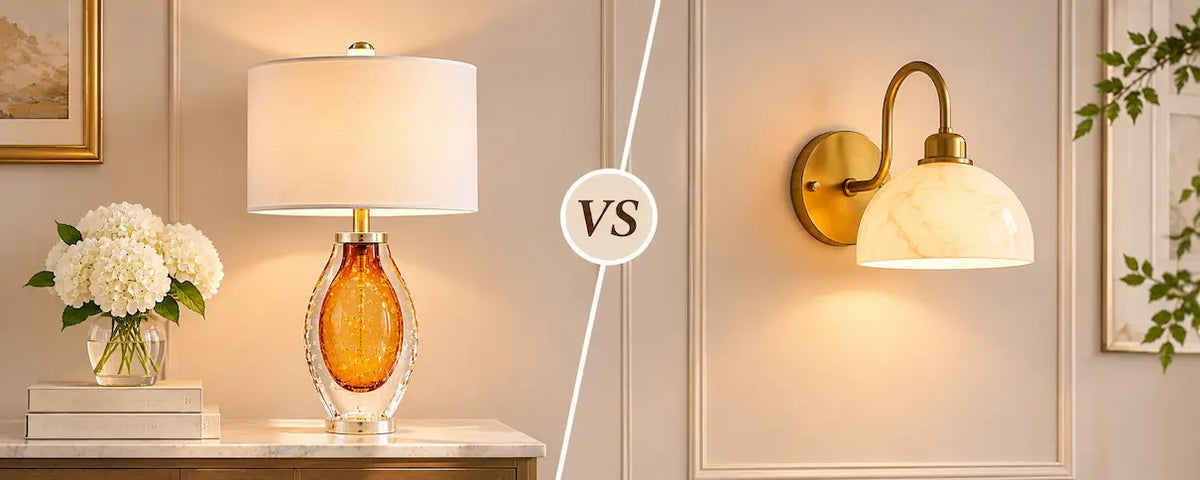
A table lamp and a wall sconce can light the same spot, but they solve different problems. One sits on furniture and moves whenever you like. The other lives on the wall, freeing up space but staying put. Choosing between a table lamp vs wall sconce comes down to how much surface you have, whether you can wire into the wall, and what you need the light for. The comparison below starts with those differences, then looks at which one tends to work better in each room.
What you'll learn:
Table Lamp vs Wall Sconce at a Glance
Side by side, the two differ most in where they sit and how they're installed.
| Table lamp | Wall sconce | |
|---|---|---|
| Where it sits | On a table, nightstand or console | Mounted on the wall |
| Surface space | Takes up part of the table | Leaves the table clear |
| Installation | Plug in and go | Hardwired by an electrician, or a plug-in model with a visible cord |
| Moving it later | Easy, just pick it up | Hard, since it leaves holes or wiring behind |
| Light | Spreads around the table and lower part of the room | Sits higher and can be aimed, especially on a swing arm |
| Renters | Works anywhere | Plug-in models only, in most rentals |
| Style | Adds a decorative object to the room | Keeps the look clean and built-in |
The Key Differences Between Table Lamps and Wall Sconces
The table gives the short version. Each of those differences plays out a little more in daily use, so it's worth looking at them one at a time.
Space
Space is usually the first reason people consider a sconce. A table lamp takes up a good share of a small nightstand or side table, leaving less room for a book, a phone or a glass of water. A wall sconce frees that surface entirely, which makes it a strong choice for narrow rooms or a bed with small nightstands.
Installation
This is where the two differ most. A table lamp just plugs into the nearest outlet. A sconce comes in two kinds:
- Hardwired sconces connect to wiring inside the wall, so the result looks clean, but the job usually needs an electrician and is easiest to plan during a renovation.
- Plug-in sconces mount on the wall and plug into an outlet, which skips the electrician, but the cord runs down the wall unless it's hidden with a cord cover.
Light
The two also light a space differently. A sconce sits higher, closer to head height, and a swing-arm model can be aimed right where you need it, which helps for reading. A table lamp spreads a softer glow around the table and the lower part of the room, and it may need a brighter bulb if you read by it. Either one can glare if the bulb sits too close to eye level, so the shade matters as much as the position.
Flexibility
A table lamp is the easy one to change. You can move it to another room, swap the shade or replace it entirely in a minute. A sconce stays where it's mounted, and replacing a hardwired one later may leave holes that the new fixture doesn't cover.
Everyday use
Small details add up over time. A sconce's switch sits on the fixture or the wall, so it's easy to reach from bed, while a table lamp's cord switch can slip behind the furniture. On the other hand, a table lamp is easier to dust and to change a bulb in, since it sits within easy reach.

Table Lamp or Wall Sconce: Which Works Better in Each Room?
Those differences don't add up to one winner. Instead, each room tips the balance one way or the other.
| Room or spot | Usually the better pick | Why |
|---|---|---|
| By the bed | Sconce for a small or no nightstand, table lamp for a wide one | A sconce frees the surface and puts light at head height |
| Beside the sofa | Table lamp | It moves with the furniture and doubles as decor |
| Entryway | Either, sconces if the console is busy | Sconces beside a mirror keep the console clear |
| Bathroom | Sconce | Counters stay wet and cluttered, and sconces light your face evenly |
| Reading nook | Swing-arm sconce, or a table lamp if there's a side table | A swing arm can be pulled close to the page |
Here's a closer look at each one.
By the bed
The bedside is where the choice comes up most often. A sconce is the better fit when the nightstand is small or there isn't one at all, and it puts reading light right at head height. A common guideline is to mount it so the light sits about 24 to 28 inches above the mattress, roughly at eye level when you sit up.
A table lamp suits a wider nightstand and anyone who likes to change the look now and then. Its shade works best at about eye level when you're sitting up, which is the key to choosing how tall a bedside lamp should be.
Beside the sofa
In the living room, table lamps usually win. Sofas get moved and rearranged, and an end table is a natural home for a lamp that doubles as decor, with plenty of lamp next to sofa ideas to suit different layouts and styles. Sconces earn their place on the walls around the seating area instead, such as a pair flanking a fireplace or a piece of art.
In the entryway
An entry console can hold a lamp, but it often holds keys, mail and a bowl as well. A pair of sconces on either side of a mirror keeps the console clear and lights your face as you head out. A single table lamp works well when the console is deep enough to hold it comfortably.
In the bathroom
The bathroom is the one room where sconces are the clear choice. Counters stay wet and cluttered, and a sconce on each side of the mirror lights your face evenly without the shadows an overhead light casts. If the sconce has a stone shade such as alabaster, it's best kept away from shower steam.
In a reading nook
A reading chair without a table beside it is a natural spot for a swing-arm sconce, which can be pulled close for reading and pushed back afterward. If there's a side table next to the chair, a table lamp with a shade that sits near eye level does the same job.
Using Table Lamps and Wall Sconces Together
As the room-by-room picture shows, the choice doesn't have to be either-or. Many of the best-lit rooms use both, each doing the job it's best at.
- Sconces for the walls, lamps for the tables. In a living room, sconces beside a fireplace or art add light at mid-height, while lamps on end tables fill in around the seating.
- Sconces by the bed, a lamp across the room. Bedside sconces free up the nightstands, and a table lamp on a dresser balances the light on the other side.
- A matching material. Choosing a sconce and a lamp in the same material, such as alabaster, glass or brass, ties the two together even when the shapes differ.
Mixing the two also gives you more control over the mood, since you can switch on only the lights a moment needs.
The Bottom Line
A table lamp is the easier, more flexible choice: it plugs in anywhere, moves with you and adds a decorative piece to the room. A wall sconce is the better fit when surface space is tight or you want light at head height, as long as you can hardwire it or don't mind a plug-in cord. By the bed and in the bathroom, sconces often have the edge, while table lamps tend to win beside the sofa. In most homes, the best answer is a mix of both.
FAQ
Are wall sconces better than table lamps for reading in bed?
Wall sconces are often better for reading in bed, because they sit closer to head height and a swing-arm model can be aimed at the page. A table lamp works well too, as long as the bottom of its shade sits at about eye level when you're sitting up. The main thing to avoid with either one is a bare bulb shining straight into your eyes.
Can you use wall sconces if you rent?
Yes, renters can use plug-in wall sconces, which mount on the wall with a few screws and plug into a regular outlet instead of being wired in. The trade-off is a visible cord running down the wall, which a cord cover painted to match the wall can hide. Small screw holes are usually easy to fill when you move out, but it's worth checking your lease first.
How high should a bedside wall sconce be?
A bedside wall sconce usually looks and works best when the light sits about 24 to 28 inches above the top of the mattress, roughly at eye level when you sit up in bed. Another way to check is to sit up against the headboard and aim for the bottom of the shade to sit just above your shoulder. That height lights a book without shining in your eyes.
Do wall sconces give enough light for a room?
Wall sconces usually don't light a whole room on their own. They work best as accent or task lighting, such as beside a bed, a mirror or a fireplace, alongside a ceiling light or table lamps. A pair of sconces can light a small bathroom or a narrow hallway well, but in a living room or bedroom, they're most effective as one layer among several.
