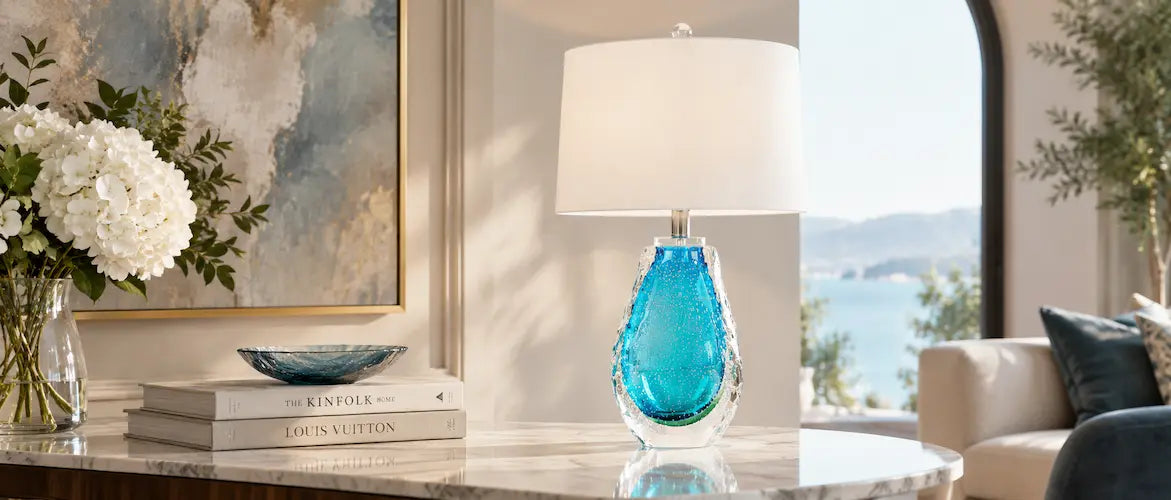
What Is a Murano-Style Table Lamp?
If you've been looking at glass table lamps, you've probably seen "Murano style" in a lot of product names. Murano is a small island near Venice, Italy, famous for colorful, hand-blown art glass. A Murano-style lamp borrows that look, but it isn't made on the island. Below, you'll find what gives these lamps their look, how they differ from real Murano glass, and how to choose a good one.
What you'll learn:
What Is a Murano-Style Table Lamp?
A Murano-style table lamp is a lamp with a decorative glass base in the style of Venetian art glass: hand-blown, heavy, and colored from within, with effects like swirls of color sealed inside clear glass or bubbles trapped in the middle. The name comes from Murano, an island near Venice that has been famous for its glass since 1291. "Murano style" means the lamp follows that look and craft, but it was made somewhere other than the island.
What ties these lamps together is how the glass looks and how it's made:
- Hand-blown bases: the glass is shaped by blowing, so no two lamps are exactly alike.
- Color inside the glass: color sits within thick clear glass rather than painted on the surface, which gives it depth.
- Organic shapes: teardrops, ovals and globes are common, shapes that come naturally from blown glass.
- Light that changes the piece: when the lamp is on, light passing through the base brings out colors and details you don't see in daylight.

What Makes a Lamp Look Murano-Style?
Most Murano-style lamps fall into a few looks. Knowing which one you like makes it easier to narrow down your choices, and each has a traditional name you'll sometimes see in product descriptions.
| Look | What You'll See | Where It Stands Out |
|---|---|---|
| Layered color (sommerso) | One or two colors that seem to float inside thick clear glass, often in a teardrop shape | A bold accent beside a sofa or on an entry console |
| Bubbles (bullicante) | Air bubbles trapped inside the glass, from a few large ones to many tiny seeded ones | Relaxed rooms, since the bubbles catch the light when the lamp is on |
| Metallic flecks (aventurine) | Tiny sparkling flecks, usually copper toned, inside the glass | Warm color schemes, adding sparkle without bright color |
Layered color is the look you'll see most often in table lamps. It suits a heavy base, since the weight keeps the lamp steady and the thick glass lets light glow through the color.
Murano-Style vs Real Murano Glass: What's the Difference?
The main difference is where the lamp is made. Real Murano glass comes from glassworks on the island of Murano. A Murano-style lamp has a similar look and is made with similar techniques, but it's made somewhere else, which is why it usually costs less.
So how do you know a lamp is real Murano glass? Look for the Vetro Artistico Murano trademark. The Veneto Region created it in 1994, and only glassworks on the island that pass inspection can put its label on their pieces. Without that label, a "Murano glass" claim is hard to verify.
| Murano-Style Lamp | Real Murano Glass Lamp | |
|---|---|---|
| Where it's made | Outside Murano | On the island of Murano |
| How to tell | Usually says "Murano style" in the name or description | Comes with the Vetro Artistico Murano label |
| Look | Can be very close: layered color, bubbles, hand-blown shapes | The same effects, made by island workshops |
| Price | Lower | Higher |
Which one should you choose? If you're buying for the look, a well-made Murano-style lamp gets you there for less. If origin matters to you, say for a collection or a special gift, look for the label. Either way, the label only tells you where a lamp was made, not how well it was made. That's what the next section helps you check.
How to Spot a Well-Made Murano-Style Lamp
Since "Murano style" isn't a certification, the quality is up to the maker. A few checks tell a hand-blown base from a cheap molded one.
- Check the bottom. Hand-blown glass usually has a pontil mark, a small rough or polished spot where the glass was held during shaping. A perfectly smooth, uniform base suggests a molded piece.
- Feel the weight. Thick, hand-blown glass feels heavy for its size. A light base often means thin glass.
- Look for small irregularities. Slight differences in shape and a few tiny bubbles are normal in hand-blown glass. Perfect symmetry on every lamp in a set is a warning sign.
- Look at the color in the thick parts. In layered glass, the color runs deep inside the base. Cheaper pieces sometimes use a thin colored coating that looks pale or uneven at the edges.
The same checks work for certified Murano glass too, which is a useful way to judge any glass lamp before you buy.

Where a Murano-Style Table Lamp Works Best
Once you've found a lamp you like, the next question is where to put it. Because the base is the main feature, a Murano-style lamp does best where people see it up close and where light can pass through the glass.
- Beside a sofa: an end table puts the base at eye level when you're seated, and the glow shows up in the evening.
- On an entry console: a pair of colored glass lamps is one of the simplest ways to make an entryway feel finished.
- On a nightstand: smaller, softer-toned bases like smoky or amber glass suit a bedroom without feeling too bold.
For any spot, the right height still matters as much as the glass, and our table lamp height guide covers every room.
Conclusion
A Murano-style table lamp uses Murano's glassmaking techniques, like layered sommerso color and trapped bubbles, without being made on the island. Only lamps with the Vetro Artistico Murano label can claim Murano origin. If you're after the look rather than the provenance, a well-made Murano-style lamp, heavy, hand-blown and colored deep in the glass, gets you most of the way there for less.
FAQ
Is a Murano-style lamp the same as Murano glass?
No. A Murano-style lamp uses the techniques and look of Murano glass but is made elsewhere. Glass sold as Murano glass is meant to come from the island of Murano near Venice, and certified pieces carry the Vetro Artistico Murano trademark label, which only inspected glassworks on the island can use.
Are Murano-style lamps hand blown?
Many are, but not all. "Murano style" describes a look, not a method, so it's worth checking the listing and the lamp itself. Hand-blown bases usually have a pontil mark on the bottom, feel heavy for their size, and show small irregularities in shape. A perfectly uniform, lightweight base is more likely molded.
How can you tell if a glass lamp is real Murano glass?
The clearest sign is the Vetro Artistico Murano trademark label, which only certified glassworks on Murano can use. Without it, a hand-blown look alone doesn't prove origin, since glassmakers elsewhere use the same techniques. If a seller claims Murano origin, it's reasonable to ask which workshop made the piece.
Are Murano-style table lamps worth it?
For most people buying for looks, yes, as long as the lamp is well made. A good Murano-style lamp gives you hand-blown glass, layered color and the glow of light through a thick base at a lower price than certified Murano glass. The value comes down to the glass quality, so check the weight, the base and the color depth before you buy.
