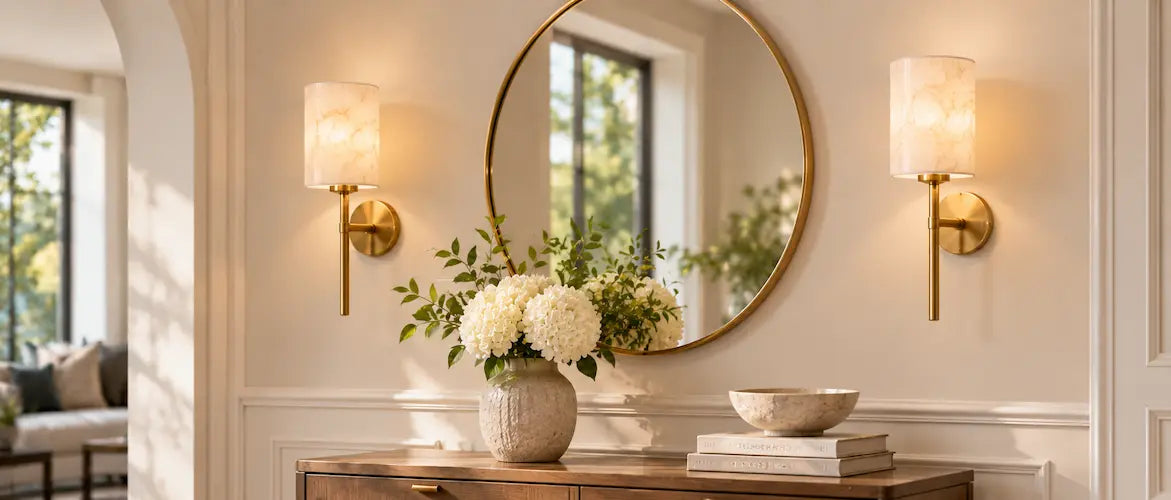
Wall Sconce Height Guide
A wall sconce only works if it sits at the right height. Too low, and it glares into your eyes and lights mostly the floor. Too high, and it washes the ceiling while the room below stays dim. Because a hardwired sconce is hard to move once the wall is patched, it pays to settle the height before anyone drills. Below is how high to hang wall sconces, starting with the standard height and then adjusting it for each room.
What you'll learn:
Wall Sconce Height Tool: See It to Scale
Pick where the sconce goes and adjust the sliders. The drawing is to scale, and the shaded band is the recommended height range for that spot.
Wall Sconce Height Tool
Pick where the sconce goes, adjust the sliders, and see it on a wall drawn to scale. The shaded band is the recommended height range for that spot.
Recommended ranges are measured to the center of the sconce: about 60 to 66 in above the floor in most rooms (up to 72 in a living room with a tall ceiling), 24 to 28 in above the mattress by the bed, about 60 in above the step below on stairs, and about 48 in beside a reading chair. The people and furniture are drawn at typical sizes for scale only.
The Standard Wall Sconce Height
In most rooms, a wall sconce looks and works best when its center sits about 60 to 66 inches above the floor. That puts the light a little above eye level for most adults, so the shade hides the bulb while the glow still reaches the room. In rooms with tall ceilings, it can rise toward 72 inches.
How you measure matters as much as the number. These heights refer to the center of the fixture, not the top, the bottom or the electrical box. The box often sits a few inches above or below the fixture's center, depending on where the mounting plate is on that model, so it's worth checking the product's dimensions before an electrician sets the box.
The standard height is a starting point. The room, the furniture under the sconce and the people using it all shift it up or down, as the next section shows.

Wall Sconce Height by Room
Each room adjusts that standard height for the way the light is used. The table gives the usual range, and the notes below explain the reasoning for each.
| Room or spot | Height to the center of the sconce |
|---|---|
| Living room | About 60 to 72 in above the floor |
| Hallway or entryway | About 60 to 66 in above the floor |
| Bathroom vanity | About 60 to 66 in above the floor |
| By the bed | About 24 to 28 in above the mattress |
| Staircase | About 60 in above the step below it |
| Over a kitchen counter | About 60 in above the floor |
| Beside a reading chair | About 48 in above the floor |
Living room
In a living room, sconces mostly add soft, ambient light, so the full standard range of 60 to 72 inches works. The higher end suits tall ceilings and walls with art. Wherever they go, the bulb shouldn't be visible from a seat on the sofa.
Hallway and entryway
Hallways and entries are walked through rather than sat in, so the standard 60 to 66 inches keeps the light at a comfortable level for people passing by. Sconces on either side of an entry mirror or console look best at the same height as each other.
Bathroom vanity
Beside a mirror, sconces at about 60 to 66 inches light your face evenly from both sides, without the shadows an overhead light casts. They usually sit about 18 inches on either side of the sink's center, so roughly 36 inches apart. Stone shades such as alabaster are best kept away from shower steam, which is part of cleaning alabaster lighting the right way.
By the bed
Bedside sconces are measured from the mattress rather than the floor, since that's where your head is. About 24 to 28 inches above the mattress, or just above your shoulder when you sit up, gives good light for reading without shining in your eyes. When you're deciding between this and a lamp on the nightstand, it helps to compare a table lamp vs wall sconce by the bed first.
Staircase
On stairs, the floor keeps changing, so the height is measured from the step directly below each sconce. About 60 inches above the tread keeps every fixture at the same visual height as you climb.
Kitchen and reading spots
Task sconces sit lower than decorative ones because they light a surface. Over a kitchen counter, about 60 inches from the floor works well, and beside a reading chair, about 48 inches puts the light at the page rather than above your head.

How Far Apart to Space Wall Sconces
Height is only half of placement once there's more than one sconce. Spacing decides whether the light looks even or patchy, and it depends on what the sconces are framing.
- Along a hallway: about 8 to 10 feet apart gives overlapping pools of light without dark gaps in between.
- On a long wall in general: at least 6 feet apart keeps them from looking crowded.
- Beside a bathroom mirror: about 36 inches apart, or roughly 18 inches on either side of the sink's center, so each one lights one side of your face.
- Beside a bed, fireplace or piece of art: centered on whatever they frame, with each sconce the same distance from the center line.
When sconces come in a pair, matching their height matters more than hitting an exact number. Two sconces an inch apart in height are easy to spot across a room.
How to Adjust Sconce Height for Your Space
The ranges above assume an average room and an average fixture. A few things can push your sconces higher or lower within them.
- Ceiling height. With 8 foot ceilings, staying near 60 inches keeps the sconce in proportion with the wall. With ceilings of 10 feet or more, going a little above 66 inches stops it from looking low.
- Fixture size. A tall sconce centered at 66 inches reaches higher and lower than a small one. It's worth checking that the bottom of a large fixture still clears anything below it, such as a console, a headboard or a faucet.
- Light direction. An up-light sconce washes the wall and ceiling, so it can sit a little higher. A down-light or an open shade sits better slightly lower, where its light lands on the space below rather than in your eyes.
- The people using it. In a home where most people are over 6 feet tall, raising sconces a few inches keeps the bulb out of their line of sight.

Common Wall Sconce Height Mistakes
Most sconce problems come from a handful of small measuring slips, and all of them are easier to avoid than to fix after the wall is patched.
- Measuring to the box instead of the fixture. The electrical box and the fixture's center are rarely at the same height, so a box set at 66 inches can leave the sconce noticeably higher or lower.
- Hanging bedside sconces by the floor. A bed's height varies a lot, so a floor measurement that suits one bed can land too low or too high on another. Measuring from the mattress avoids that.
- Ignoring what's below. A sconce that's the right height on paper can still crowd a headboard, a mirror frame or a tall lamp beside it.
- Mismatched pairs. Small differences in height are obvious when two sconces sit side by side, so it's worth marking both from the same level line.
The Bottom Line
Most wall sconces look best with their center about 60 to 66 inches above the floor, rising toward 72 inches in living rooms with tall ceilings. Bedside sconces are the exception, measured from the mattress at about 24 to 28 inches, while stair sconces are measured from the step below. Beside a mirror, about 36 inches apart works well, and along a hallway, 8 to 10 feet apart keeps the light even. Checking where the electrical box sits relative to the fixture's center is the last step before anyone drills.
FAQ
What is the standard height for a wall sconce?
The standard height for a wall sconce is about 60 to 66 inches from the floor to the center of the fixture. That puts the light just above eye level for most adults, so the shade hides the bulb. In living rooms with taller ceilings, sconces can go up to about 72 inches, while task sconces, such as beside a reading chair, often sit lower.
How high should a bedside wall sconce be?
A bedside wall sconce usually works best about 24 to 28 inches above the top of the mattress, measured to the center of the fixture. Another simple check is to sit up in bed and place the sconce just above your shoulder. That height lights a book or the nightstand without shining into your eyes when you're lying down.
How high should sconces be next to a bathroom mirror?
Sconces next to a bathroom mirror usually sit about 60 to 66 inches above the floor, measured to their center. That height is close to face level, so the light reaches your face evenly from both sides. They're typically spaced about 36 inches apart, or around 18 inches on either side of the sink's center.
How far apart should hallway sconces be?
Hallway sconces are usually spaced about 8 to 10 feet apart. That spacing lets the pools of light from each sconce overlap slightly, so the hallway doesn't have dark patches between them. In a short hallway, a pair of sconces placed evenly along the wall, or one at each end, is often enough.
